Anki
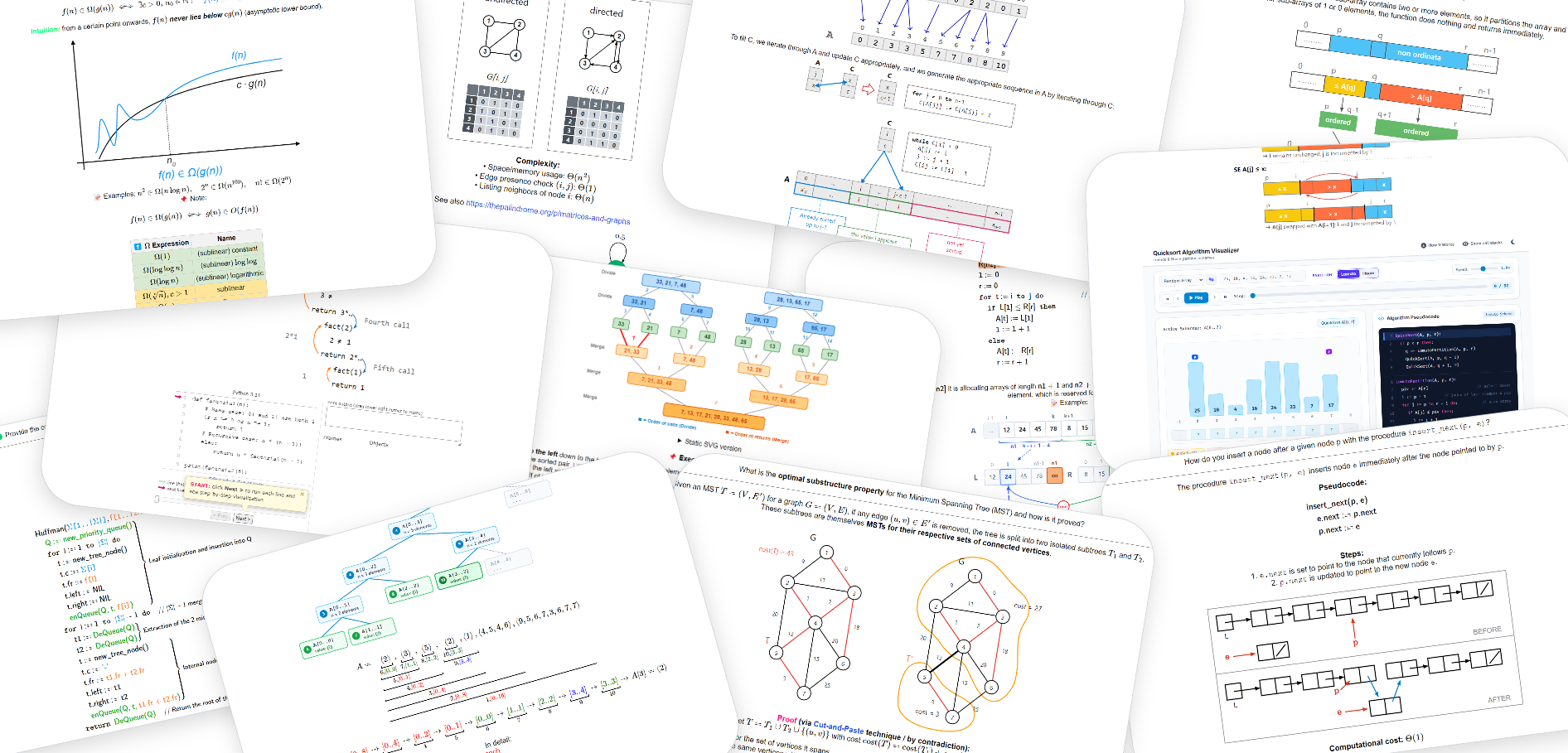
Here are some of the decks I made on Anki while studying Computer Science at university. I translated all the flashcards in English too, so there are links for both the Italian and English versions.
info Note:
More decks and add-ons on my AnkiWeb author page.
Card collages made with PicPitch Collage 🖼️ (code).
Read how I create these decks on my dedicated post.
volunteer_activism Support
If you find these decks useful, please leave a rating! I spent several days creating them, and if you feel generous and want to support my work, encouraging me to create more high-quality decks, you can freely support me here.
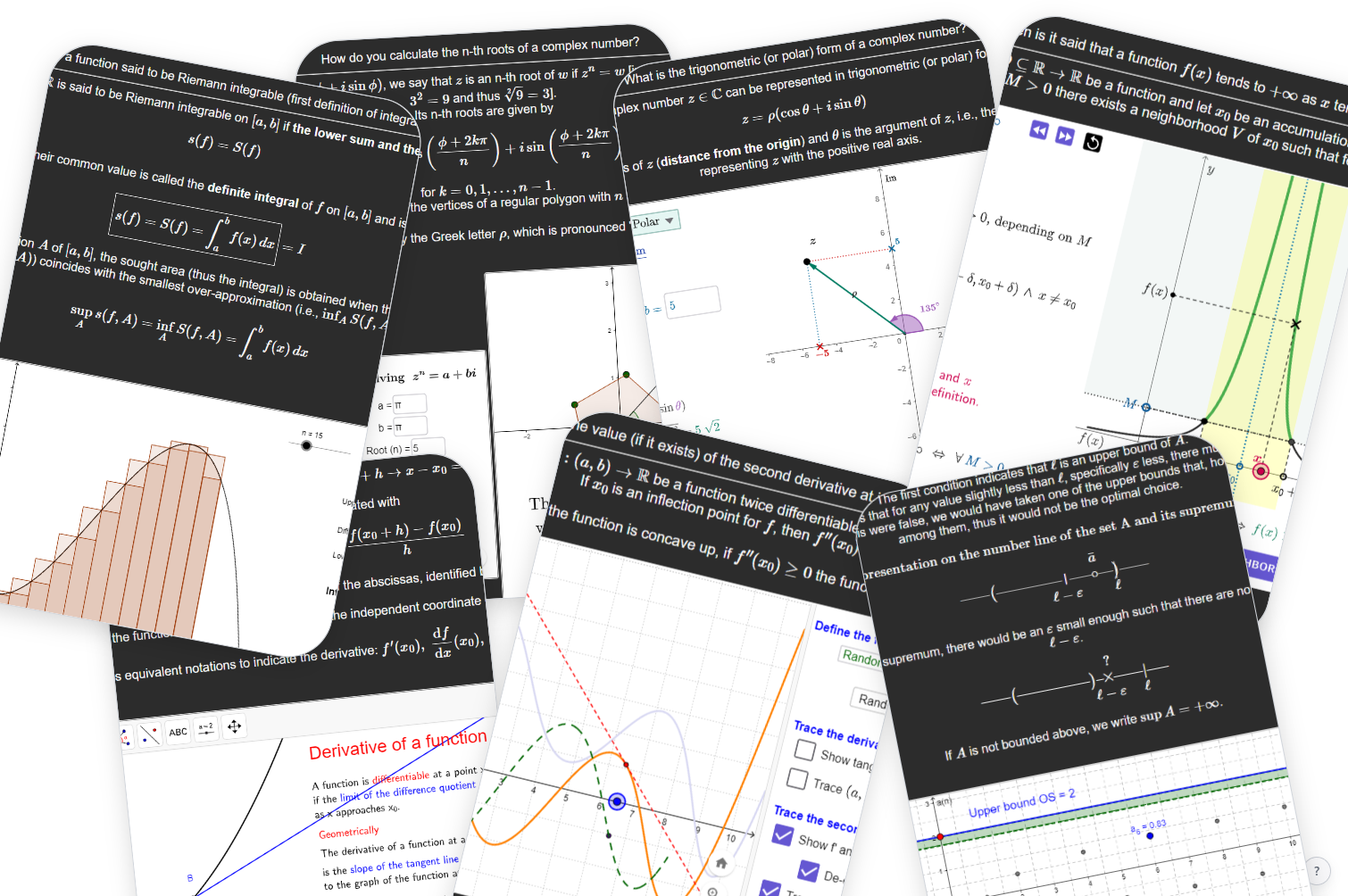
Ho creato questo mazzo per supportare lo studio di Analisi 1 per l’indirizzo di Informatica all’università. Ho cercato di includere tutte le informazioni essenziali in modo chiaro e ben formattato, con l’obiettivo di rendere lo studio più efficace possibile.
Il mazzo è interamente testuale (non ho inserito migliaia di immagini o video) quindi il suo peso è di pochi kilobyte, ma per arricchirlo con visualizzazioni grafiche ho integrato numerosi embed HTML interattivi di Geogebra tra quelli che risultavano più utili reperibili online e alcuni clip video esplicativi da YouTube per una comoda consultazione.
Alcune flashcard potrebbero risultare particolarmente lunghe, ma questo è stato un compromesso necessario tra numero di carte e contenuto per carta. Personalmente, queste carte mi sono state fondamentali per superare Analisi 1, e spero che possano essere altrettanto utili a chiunque le utilizzi.
⚠ Nota: Le sample card potrebbero non essere visualizzate correttamente sul sito di Anki, quindi consiglio di scaricare il mazzo e testarlo direttamente nell’applicazione Anki.
Struttura mazzo:
Numeri naturali e Principio di induzione
Campi ordinati
Numeri complessi
Successioni
Notazioni asintotiche
Serie
Limiti di funzioni reali di variabile reale (+ Limiti notevoli)
Calcolo differenziale per funzioni reali di variabile reale (+ Derivate fondamentali e regole di derivazione)
Approssimazione e formule di Taylor
Proprietà delle funzioni continue su un intervallo
Calcolo differenziale e problemi di ottimizzazione
Studio del grafico di funzioni reali di una variabile reale
Calcolo integrale (+ Integrali notevoli e tecniche di integrazione)
Integrali generalizzati
I created this deck to support my study of Calculus 1 while attending university in Italy (Computer Science). I aimed to include all essential information in a clear and well-formatted way, making studying as effective as possible.
The deck is entirely text-based (I did not add thousands of images or videos), so its size is just a few kilobytes. However, to enhance it with graphical visualizations, I integrated several interactive HTML embeds from Geogebra, selecting the most useful ones available online, along with explanatory video clips from YouTube for convenient reference.
Some flashcards might be quite long, but this was a necessary compromise between the number of cards and the content per card. Personally, these cards were crucial for me to pass Calculus 1, and I hope they will be just as helpful for anyone using them.
⚠ Note: Sample cards might not display correctly on the Anki website, so I recommend downloading the deck and testing it directly in the Anki application.
Deck structure:
Natural Numbers and the Principle of Induction
Ordered Fields
Complex Numbers
Sequences
Asymptotic Notations
Series
Limits of Real-Valued Functions (+ Notable Limits)
Differential Calculus for Real-Valued Functions (+ Fundamental Derivatives and Differentiation Rules)
Approximation and Taylor Series
Properties of Continuous Functions on an Interval
Differential Calculus and Optimization Problems
Graphing Real-Valued Functions of a Single Variable
Integral Calculus (+ Notable Integrals and Integration Techniques)
Generalized Integrals
Computer architecture
Boolean logic, RISC-V assembly, and processor design with simulators and exercises.
Questo è probabilmente il deck più curato di internet su Architettura dei calcolatori, logica booleana e assembly RISC-V. È basato sul corso “Architettura dei calcolatori 1” svolto nel primo anno delle università italiane di Informatica. Non è un semplice mazzo di flashcard da “ripassare al volo”: alcune carte sono piuttosto lunghe, ma questa scelta garantisce spiegazioni esaustive senza frammentare troppo i contenuti da studiare.
Questo deck è pensato sia per chi vuole apprendere i fondamenti dell’informazione, della logica di Boole e delle Macchine a Stati Finiti (FSM), sia per chi desidera imparare l’assembly RISC-V o capire nel dettaglio il funzionamento di un processore. Non è una guida esaustiva, ma un supporto completo che facilita la comprensione dei concetti teorici.
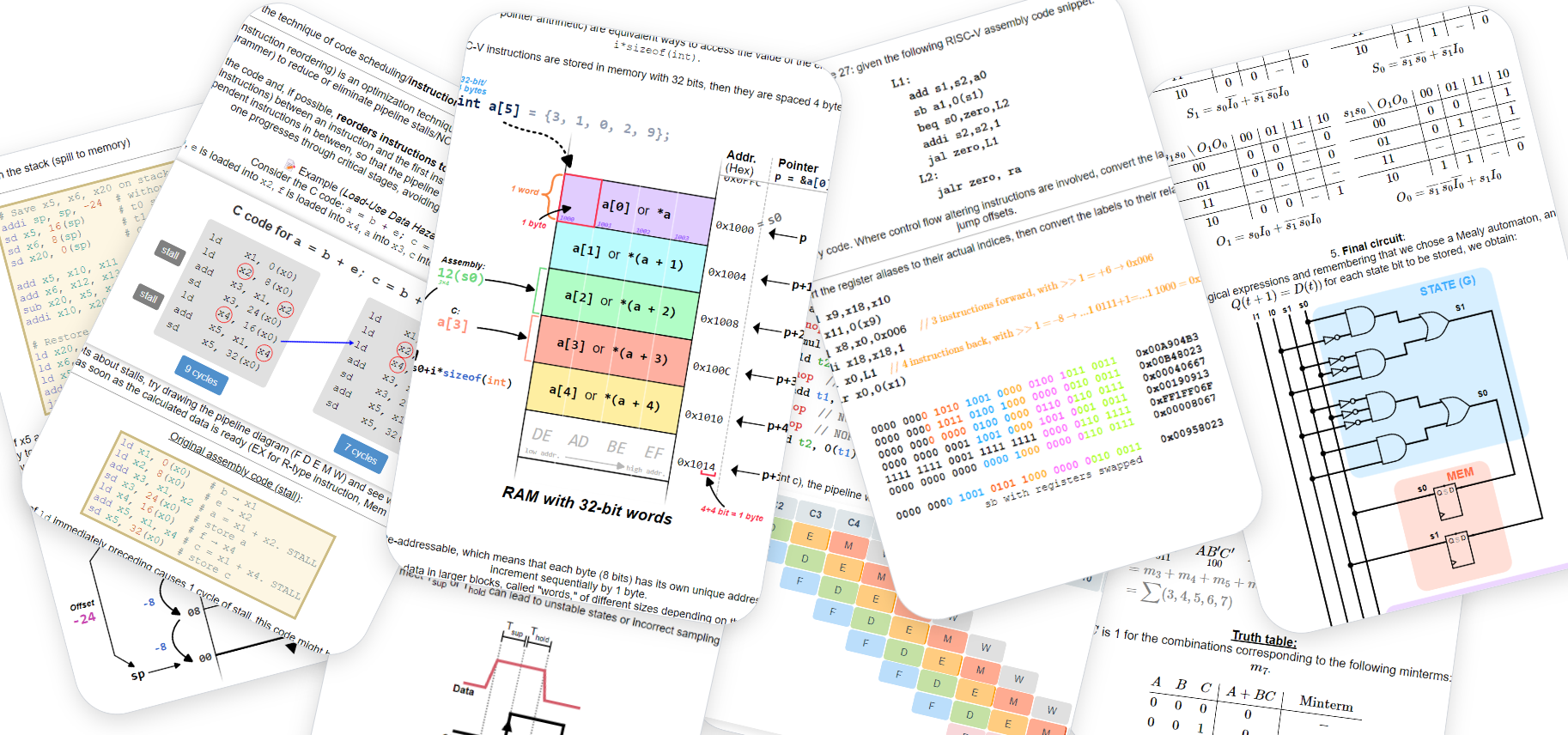
Ho cercato di strutturare ogni flashcard in modo chiaro e ben formattato, con tutte le informazioni essenziali e diverse figure per la comprensione visiva, e sono inclusi in subdeck separati anche diversi esercizi svolti, tabelle di riferimento, simulatori di CPU (e altri embed di piccoli circuiti interattivi) e molto altro (da non imparare a memoria ma molto utili per comprendere a fondo la teoria).
Struttura mazzo:
Architettura calcolatori 1
├── 01 Computer, Performance e Reti logiche
│   ├── 01 Computer e prestazioni
│   ├── 02 Rappresentazione dell'informazione
│   └── 03 Reti logiche
├── 02 ISA RISC-V & Procedure Calling
│   ├── Esercizi assembly
│   └── Instruction reference
└── 03 Processore (Datapath, Controllo e Pipelining)
    ├── Esercizi
    └── Simulatori
🖼️ Sono incluse molte immagini vettoriali SVG (per mantenere il mazzo leggero e garantire qualità pixel-perfect) e stili CSS personalizzati. È consigliabile scaricare l’intero deck per visualizzare correttamente le anteprime delle carte. Ho curato la compatibilità con i temi chiaro/scuro di Anki e, in parte, anche con i dispositivi mobili.
📕 Parte del materiale è basato sul libro Computer Organization and Design (RISC-V Edition): The Hardware Software Interface di Patterson & Hennessy, ma:
- Molti capitoli sono stati sintetizzati o semplificati per evitare dettagli superflui all’inizio del deck.
- Sono state aggiunte sezioni introduttive all’algebra di Boole, alla logica combinatoria/sequenziale, all’informazione e altri argomenti in modo da rendere più accessibile lo studio ai principianti.
- Alcune parti troppo approfondite o non strettamente necessarie sono state escluse.
This is probably the most carefully crafted deck on the internet for Computer Architecture, Boolean logic, and RISC-V assembly. It is based on the course “Computer Architecture 1” taught in the first year of Italian universities of Computer Science. It’s not just a simple set of flashcards to “review on the fly”: some cards are quite long, but this choice ensures comprehensive explanations without overly fragmenting the material.
This deck is designed both for those who want to learn the fundamentals of information theory, Boolean logic, and Finite State Machines (FSM), and for those who wish to learn RISC-V assembly or understand in detail how a processor works. It is not an exhaustive guide, but a complete support that makes it easier to grasp the theoretical concepts.
I have structured each flashcard clearly and formatted it well, including all essential information and various illustrations for visual understanding. Separate subdecks also include solved exercises, reference tables, CPU simulators (and other embeds of small interactive circuits), and much more (not meant to be memorized, but very useful to truly understand the theory).
Deck structure:
Computer Architecture
├── 01 Computer, Performance, and Logic Circuits
│   ├── 01 Computer and Performance
│   ├── 02 Information Representation
│   └── 03 Logic Circuits
├── 02 ISA RISC-V & Procedure Calling
│   ├── Assembly Exercises
│   └── Instruction Reference
└── 03 Processor (Datapath, Control, and Pipelining)
    ├── Exercises
    └── Simulators
🖼️ There are many SVG vector images included (to keep the deck lightweight and guarantee pixel-perfect quality) and custom CSS styles. It is recommended to download the entire deck to preview the cards correctly. I have ensured compatibility with both Anki’s light and dark themes, and to some extent with mobile devices as well.
📕 Part of the material is based on the book Computer Organization and Design (RISC-V Edition): The Hardware Software Interface by Patterson & Hennessy, but:
- Many chapters have been condensed or simplified to avoid superfluous details at the beginning of the deck.
- Introductory sections on Boolean algebra, combinational/sequential logic, information encoding, and other topics have been added to make the study more accessible for beginners.
- Some overly detailed or non-essential parts have been excluded.
Linear Algebra
Vector spaces, matrices, and combinatorics with MathJax formulas and interactive visuals.
Questo mazzo è focalizzato sulle basi di Algebra Lineare e Calcolo Combinatorio (matematica discreta), materie di base nei corsi universitari di Informatica, Matematica e Ingegneria. L’ho fatto negli ultimi mesi frequentando un corso di Informatica in Italia.
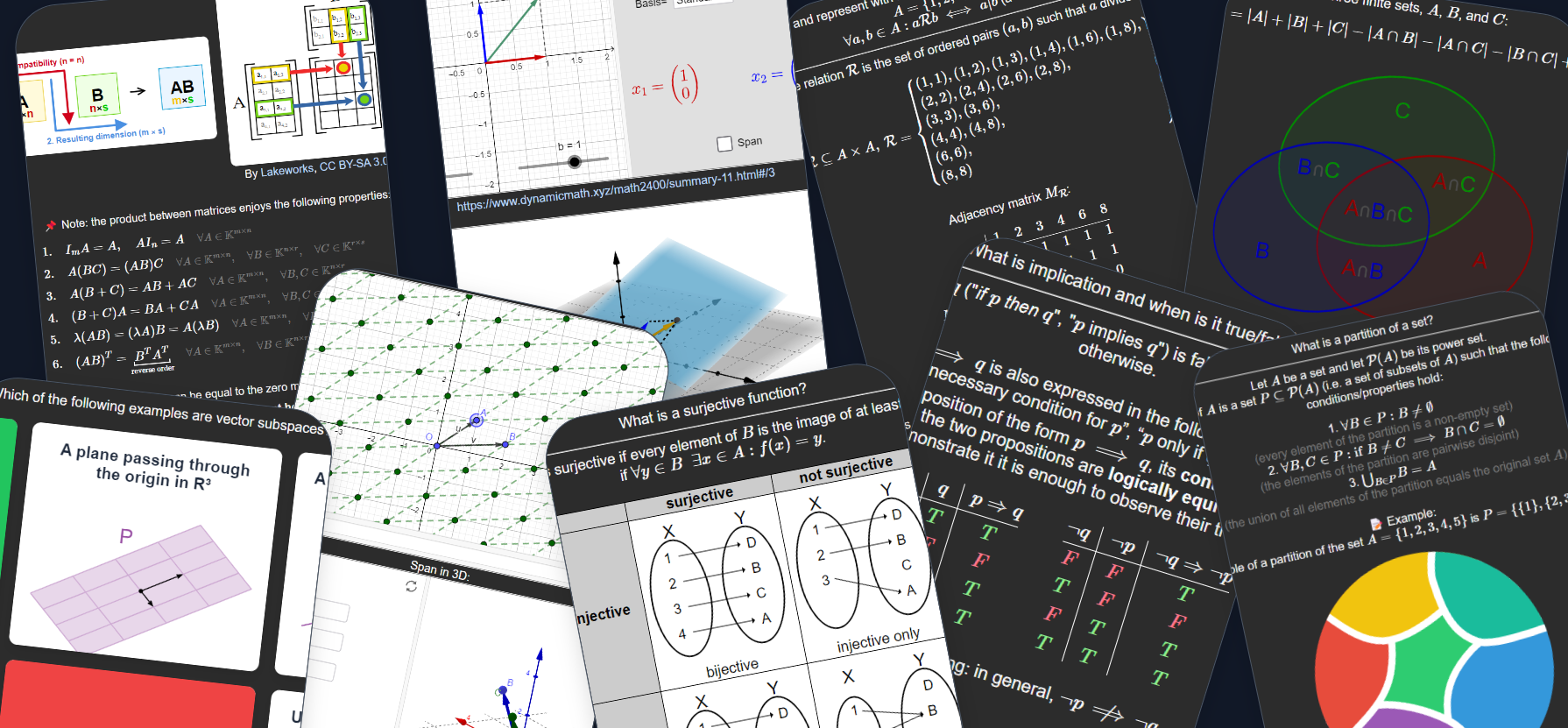
Non è solo un elenco di definizioni: ho cercato di creare un insieme di flashcard che sostituisse (almeno in gran parte) la lenta consultazione di testi esterni al sorgere di dubbi durante lo studio, combinando spiegazioni chiare e complete, esempi ed esercizi svolti, con ampio uso di MathJax, SVG ed alcuni elementi interattivi in HTML (iframe). Alcune carte sono più lunghe di una normale flashcard Anki e non sono facili da studiare al primo incontro: questa scelta un po’ controversa nasce dalla mia esigenza di mantenere il contenuto pressoché completo, non aumentare troppo il numero già alto di carte nel deck ed evitare di frammentare eccessivamente i concetti.
Il mazzo include sia teoria che pratica, in modo da coprire progressivamente tutti gli argomenti fondamentali: dalla logica e la combinatoria, fino a matrici, spazi vettoriali, autovalori/autovettori e diagonalizzazione.
Struttura mazzo:
Logica e insiemi
Relazioni e funzioni
Elementi di Calcolo Combinatorio
Operazioni, Strutture Algebriche e interi ℤ
Spazi vettoriali 𝕂ⁿ
Matrici
Sistemi Lineari
Funzioni lineari
Autovalori e diagonalizzazione
🖼️ Alcune funzionalità:
- Formule matematiche formattate con MathJax
- Schemi e illustrazioni vettoriali (SVG), no immagini raster
- Embed interattivi utili per visualizzare i concetti geometrici
- Esempi ed esercizi con soluzione dietro la carta
This deck focuses on the basics of Linear Algebra and Combinatorics (discrete mathematics), core subjects in university courses of Computer Science, Mathematics, and Engineering. I created it while attending a Computer Science course in Italy.
It is not just a list of definitions: my goal was to build a set of flashcards that could replace (at least partially) the slow consultation of external textbooks whenever doubts arise during study. The cards combine clear and complete explanations, worked examples, and exercises, with extensive use of MathJax, SVG, and some interactive HTML (iframe) elements. Some cards are longer than a typical Anki flashcard and may not be easy to study at first sight: this slightly controversial choice comes from my need to keep the content as complete as possible, avoid excessively increasing the already large number of cards in the deck, and prevent fragmenting concepts too much.
The deck includes both theory and practice, progressively covering all the fundamental topics: from logic and combinatorics to matrices, vector spaces, eigenvalues/eigenvectors, and diagonalization.
Deck structure:
Logic and sets
Relations and functions
Elements of Combinatorics
Operations, Algebraic Structures, and integers ℤ
Vector spaces 𝕂ⁿ
Matrices
Linear Systems
Linear functions
Eigenvalues and diagonalization
🖼️ Features:
- Mathematical formulas typeset with MathJax
- Vector diagrams and illustrations (SVG), no raster images
- Interactive embeds to visualize key geometric concepts
- Examples and exercises with solutions on the back of the card
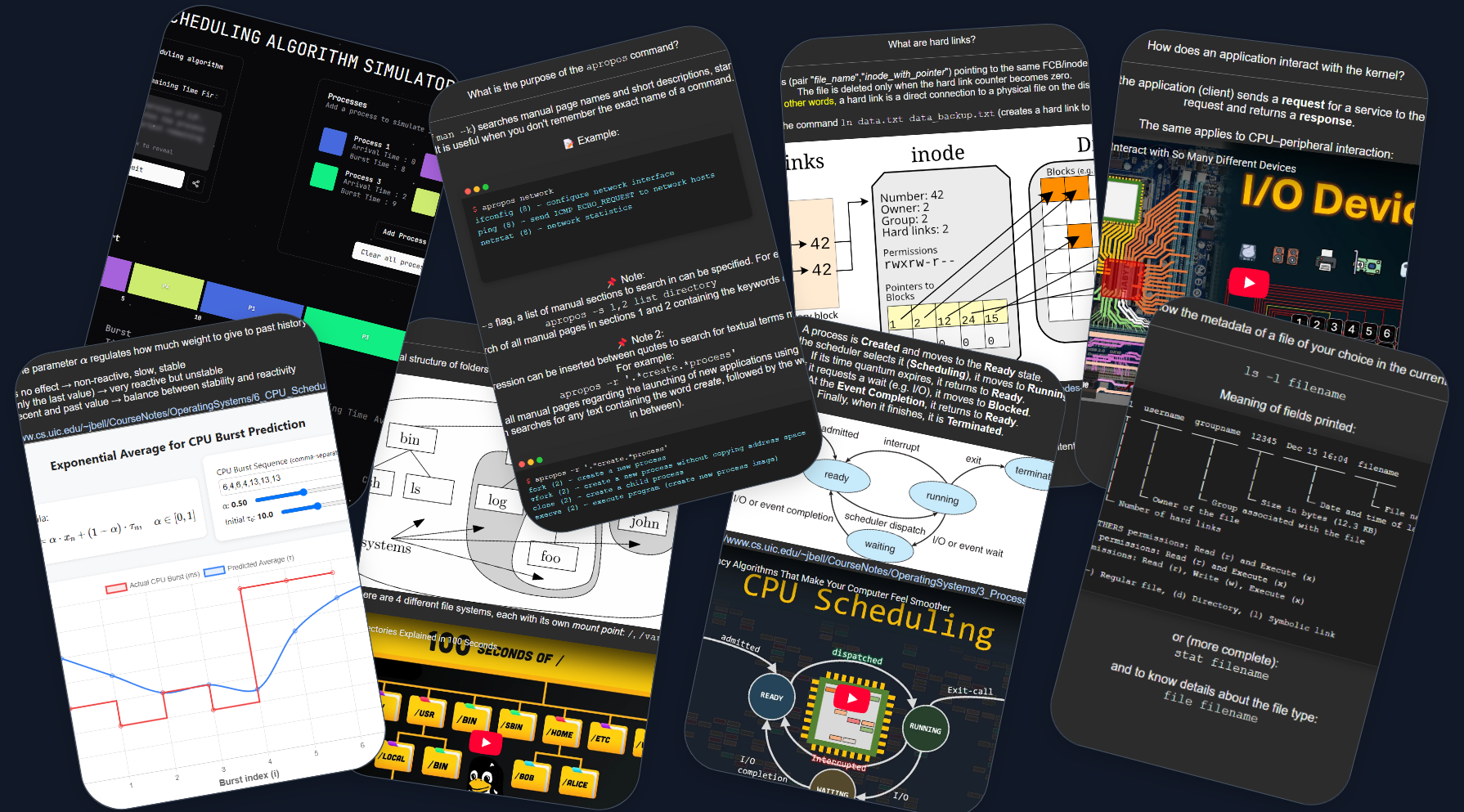
OS Concepts (Linux) & Bash
Core OS concepts (using Linux) and important Bash commands, with useful video clips, code examples and exercises.
Questo mazzo è basato su un corso universitario di Sistemi Operativi svolto in Italia, con un focus sui meccanismi interni di Linux e sui comandi base di Bash.
Le carte coprono sia i fondamenti teorici che i concetti pratici (con relativi esercizi), tra cui:
- Struttura e stratificazione dei sistemi operativi
- Spazio Kernel vs Spazio Utente, livelli di privilegio e modalità di esecuzione
- System call e la loro implementazione in Linux
- Architetture monolitiche, microkernel e kernel ibridi
- Gestione dei processi, della memoria, del file system e dell’I/O
- Componenti fondamentali di GNU/Linux e il ruolo della libreria standard C
- Concetti essenziali di Linux e Bash
Molte carte includono anche diagrammi e/o video per facilitare la comprensione (oltre ad alcune simulazioni interattive!).
Struttura mazzo:
Sistemi Operativi
├── 01 Intro, System Call e Struttura del SO
├── 02 Comandi Base del Terminale Linux
├── 03 Processi
│   └── Esercizi
├── 04 CPU Scheduling
│   └── Algoritmi di Scheduling
├── 05 File System
│   ├── Esercizi e Altri Comandi
│   ├── Implementazione di un File System
│   └── Virtual File System
└── 06 Memoria
    ├── Supporto alla Memoria
    ├── Gestione della Memoria dei Processi
Esercizi Vari
This deck is based on a university-level Operating Systems course taught in Italy, with a focus on Linux internals and basic Bash commands.
The cards cover both theoretical foundations and practical concepts (with exercises), including:
- Operating system structure and layering
- Kernel vs user space, privilege levels, and execution modes
- System calls and their implementation in Linux
- Monolithic, microkernel, and hybrid kernel architectures
- Process, memory, file system, and I/O management
- Core GNU/Linux components and the role of the C standard library
- Essential Linux and Bash concepts
Many cards also have diagrams and/or videos for better understanding (plus some interactive simulations!)
Deck structure:
Operating Systems
├── 01 Intro and System Calls and OS Structure
├── 02 Basic Linux Terminal Commands
├── 03 Processes
│   └── Exercises
├── 04 CPU Scheduling
│   └── Scheduling Algorithms
├── 05 File System
│   ├── Exercises and Other Commands
│   ├── Implementation of a File System
│   └── Virtual File System
└── 06 Memory
    ├── Memory Support
    ├── Process Memory Management
Various Exercises
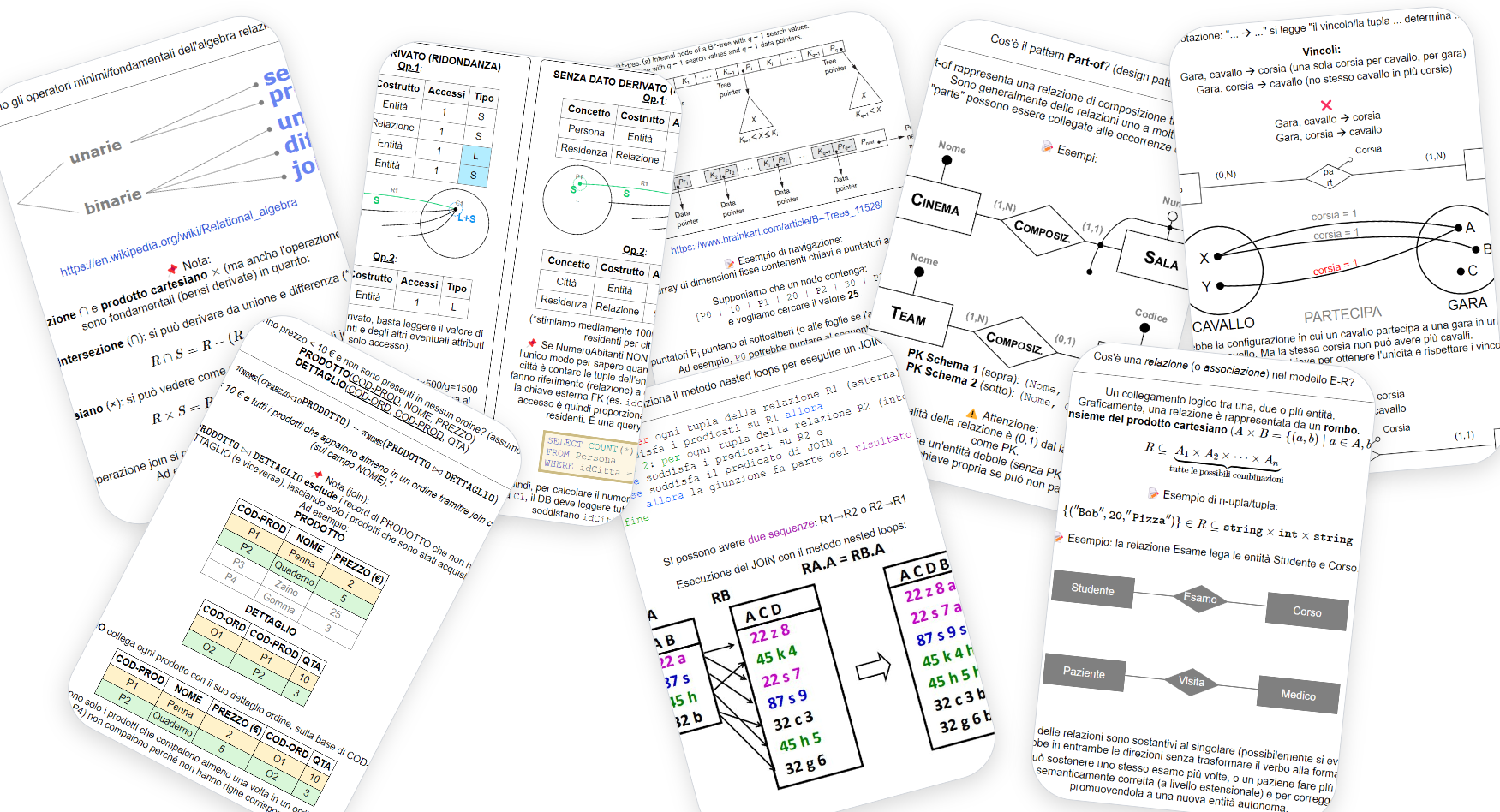
Databases & SQL
Relational database design, SQL queries, DBMS technology and more, with diagrams, examples and exercises.
Questo deck è basato su un corso universitario italiano di Basi di Dati, seguendo in larga parte il libro Basi di Dati: Modelli e Linguaggi di Interrogazione di Paolo Atzeni.
Le flashcard includono frequentemente figure e contenuti incorporati per facilitare e migliorare l’apprendimento. Sono inoltre presenti diversi esercizi (non pensati per essere memorizzati), con le soluzioni sul retro per verificare quanto appreso.
Struttura mazzo:
Basi di Dati
├── 00 Introduzione a Database e DBMS
├── 01 Modello ER e Progettazione concettuale
│   └── Esercizi
├── 02 Modello Relazionale, Algebra relazionale, SQL
│   ├── Esercizi
│   ├──── DB Esami
│   ├──── DB Mobili
│   ├──── DB Personale
│   ├──── Vari
│   └── SQL Avanzato
├── 03 Progettazione Logica e Normalizzazione
│   └── Analisi delle prestazioni
├── 04 Progettazione Fisica e Tecnologia di un DBMS
│   ├── 01 Metodi di Accesso
│   └── 02 Calcolo del Costo di Accesso ai Dati
└── 05 Programmazione DB
This deck is based on an Italian Database Systems university course, largely following the book Database Systems: Concepts, Languages & Architectures by Paolo Atzeni. The flashcards often include figures and embedded content to facilitate and improve learning. Several exercises are also included (not meant to be memorized), with solutions on the back to test what you have learned.
⚠ Note: some figures and visual materials have not been translated from Italian to English and therefore may still contain Italian text.
Deck structure:
Database Systems
├── 00 Introduction to Databases and DBMS
├── 01 ER Model and Conceptual Design
│   └── Exercises
├── 02 Relational Model, Relational Algebra, SQL
│   ├── Exercises
│   ├──── Exams DB
│   ├──── Furniture DB
│   ├──── Personnel DB
│   ├──── Miscellaneous
│   └── Advanced SQL
├── 03 Logical Design and Normalization
│   └── Performance Analysis
├── 04 Physical Design and DBMS Technology
│   ├── 01 Access Methods
│   └── 02 Data Access Cost Calculation
└── 05 DB Programming